Government Policies — August 7, 2025
Building Danantara: Is Indonesia Ready to Follow in Temasek's Footsteps?
I first came across the topic through a TikTok FYP content by the account Acres Research (Link), which discussed the formation of the Badan Pengelola Investasi Daya Anagata Nusantara (Danantara), a sovereign wealth entity touted as potentially becoming “Indonesia’s Temasek.” Two unfamiliar terms caught my attention—Danantara and Temasek—which led me to explore the issue further. Based on Google Trends data, Danantara first gained public attention on September 1, 2024, and has become a frequent topic of discussion as of November 2024.¹
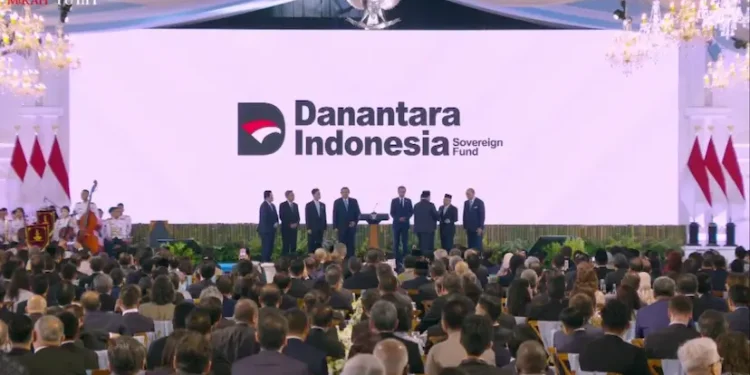
Danantara Inauguration (YouTube/Sekretariat Presiden) — source: indonesiasentinel
Let’s begin with Temasek. According to its official website, Temasek was founded on June 25, 1974, as a government-owned investment holding company in Singapore. Although it is state-owned, Temasek operates independently and transparently, publishing annual performance reports (Temasek Review). It serves as the primary shareholder of many strategic companies in Singapore and manages a vast global investment portfolio, with assets under management reaching SG$389 billion.²
Temasek invests across various sectors, including technology, financial services, transport, infrastructure, healthcare, and energy. Its portfolio spans globally, with a focus on Asia, Europe, and North America. Temasek’s investment strategy is guided by long-term structural trends. In essence, it is a sovereign investment company tasked with managing and growing national wealth by generating long-term returns, supporting economic growth, and ensuring sustainability.
Temasek initially focused heavily on domestic investments until 2002. However, by 2009, it shifted its role from supporting Singapore’s national economic development to prioritizing long-term, commercially driven wealth creation. This was executed through investment diversification into countries beyond Singapore, including Asia, Europe, America, and the Middle East. Today, Temasek continues to contribute to Singapore’s economy, including through its philanthropic initiatives.³ ⁴
Why does Indonesia need Danantara?
Let’s assume that Danantara is intended to function similarly to Temasek. The next question is: Based on media reports, Danantara was established to attract foreign investment, optimize the management of state assets, and support Indonesia’s long-term economic goals.⁵ ⁶ ⁷ The plan involves consolidating eight state-owned entities: BMRI, BBRI, PLN, Pertamina, BBNI, TLKM, MIND ID, and INA (Indonesia Investment Authority). If this consolidation succeeds, Danantara could manage approximately IDR 9,480 trillion in assets—potentially positioning it as one of the world’s largest sovereign wealth funds (SWFs).⁸
However, the planned inauguration of Danantara on November 7, 2024, was canceled. President Prabowo Subianto requested a more careful and thorough review, and the decision was also postponed pending his return from overseas travel.⁹ ¹⁰ With extensive media coverage before the planned launch and the sudden cancellation,¹ I get the impression that the government may have acted hastily and without sufficient preparation.
Regardless of whether Danantara will be launched soon or not, it faces significant challenges—both in terms of internal management and political influence, especially given Indonesia’s current political volatility. Corruption levels are also a concern. Compared to Singapore, Indonesia ranks far worse on the Corruption Perception Index (CPI): 115th versus Singapore’s 5th in 2023 (lower is better). While Indonesia’s CPI has improved slightly from 37 in 2020 to 34 in 2023, the issue remains critical.¹¹ ¹²
These insights prompted further questions in my mind
Questions that seem vital in evaluating whether Indonesia truly needs a “Temasek-like” entity:
- The legal foundation of Danantara is unclear. So why is the government rushing to launch it?
- Why is INA being consolidated into Danantara?
- In line with President Prabowo’s view, is it wise to proceed with Danantara under its current structure, considering the persistent issues of corruption, collusion, and nepotism?¹³
After considering these questions, here are my thoughts
The simplest answer might be: the government needs money. The administration has been aggressive in implementing economic policies, especially to fund large infrastructure projects and the proposed “free lunch” program promoted by the newly elected president. There’s also an urgent need to manage state-owned enterprises (SOEs) more efficiently and attract global investment for the planned national capital (IKN) in Kalimantan, which remains shrouded in uncertainty.
Looking at Indonesia’s fiscal situation over the past five years, the government has consistently run an average budget deficit of around IDR 638.5 trillion, worsened by the COVID-19 pandemic. As of July 2023, public debt had reached IDR 7,855.53 trillion. However, this annual increase in budget (largely debt-financed) hasn’t correlated with improvements in logistics performance or reductions in poverty. Indonesia’s Logistics Performance Index (LPI) remains volatile, and logistics costs as a percentage of GDP remain high. Meanwhile, rising public debt hasn’t meaningfully improved poverty levels or economic growth.¹⁴
This brings us to a confusing part. On one hand, Danantara aims to improve efficiency and returns from managing SOE assets. On the other, INA has a distinct role—managing sovereign investment funds and attracting foreign capital for strategic national projects. Consolidating INA into Danantara may improve policy coordination and investment integration, helping to align SOE asset management with national investment goals. It could also enhance funding capacity for long-term projects.
However, this merger risks introducing excessive complexity and blurring the focus of each entity. INA, which is supposed to concentrate on long-term global investments, may get dragged into managing domestically focused, policy-driven SOE assets. Worse, political interests could interfere with both investment decisions and SOE governance, threatening INA’s operational independence. This raises the fundamental question: can a fund of this size be managed transparently, effectively, and honestly?
Addressing this concern
To address this concern, a more viable solution might be keeping Danantara and INA separate. This would allow each entity to maintain its focus and strategic direction—Danantara on SOE optimization, and INA on long-term global investments. Separation would also help avoid conflicts of interest and improve operational efficiency. Still, a clear synergy framework between the two—if collaboration is needed—could offer benefits without compromising independence.
Why is separation necessary if the government insists on proceeding with Danantara? Because merging two entities with different objectives increases the likelihood of failure—by 70–90%, especially due to difficulties in cultural and operational integration, which often undermine intended synergies. Furthermore, consolidation risks reducing long-term efficiency and increasing organizational complexity.¹⁵ ¹⁶
According to an IMF report, successful sovereign wealth funds like Temasek and Norges Bank Investment Management (NBIM) operate with high independence in both decision-making and fund management. Free from political interference, they’re able to maintain sustainability and long-term performance.¹⁷ Similarly, OECD studies show that countries with separate SOE and sovereign fund management—such as Brazil and South Korea—tend to perform better in terms of transparency and asset efficiency.¹⁸
The World Bank also emphasizes the importance of separating domestic political agendas from sovereign investment strategies. Merging entities subject to political decision-making opens the door to interference that can compromise both sustainability and effectiveness in the long run.¹⁹
Remarks
At this point, I don’t think there’s a definitive answer. It may be too early to evaluate Danantara—or perhaps I simply lack the expertise to provide a sharp enough assessment. That’s my take on Danantara. What do you think?